
2pcs AHT30 High Precision
5.0Editor score
Low power consumption
Fast transmission speed
Simple circuit design
This guide compares the top Arduino temperature sensors for accuracy, range, and ease of use to help you choose the right module for your project needs.
Selecting the right temperature sensor for your Arduino project is crucial for accurate data logging and environmental monitoring. Whether you are building a weather station or a smart thermostat, the sensor you choose will define the reliability of your entire system. This guide helps you navigate the options available today.
We have evaluated ten leading temperature sensors based on their accuracy, operating range, connectivity options, and ease of integration with popular microcontrollers. Our analysis focuses on real-world performance metrics and user feedback to ensure you get a component that delivers consistent results under various conditions.
Each pick in this list highlights specific strengths such as waterproofing, humidity monitoring, or digital communication protocols. Prices and availability change frequently so please check the current listings before making your final decision. We focus on value and performance to help you build confidently.
5.0Editor score

4.7Editor score

4.9Editor score
This side-by-side comparison highlights the key specifications and unique features of each sensor to help you decide which one fits your specific application requirements best.




The Teyleten Robot SHT31-D is a high precision digital sensor that excels in both temperature and humidity monitoring. With a 0.3-degree accuracy and a wide operating range this module is perfect for professional or advanced hobbyist projects requiring stable data.
We may earn a commission when you buy through this link, at no additional cost to you.
Its I2C interface allows for easy integration with multiple devices without cluttering your microcontroller pins. The wide voltage range from 2.4V to 5.5V ensures compatibility with almost any Arduino board or power source you might have in your workshop.
While it requires pull-up resistors for I2C communication which adds a tiny bit of wiring complexity the reliability and speed of data transmission make it worthwhile. Users appreciate the consistency and the ability to track humidity alongside temperature in one package.
This sensor is ideal for anyone building weather stations or climate control systems. If you need accurate and reliable readings for a critical project this module delivers the performance you need to succeed without unnecessary complications.
The 0.3-degree Celsius accuracy ensures that your data logging is reliable even in environments with small temperature fluctuations.
The digital I2C output simplifies wiring and allows you to connect multiple sensors using just two data lines.
We may earn a commission when you buy through this link, at no additional cost to you.
The AHT30 module offers exceptional value for money while delivering high precision measurements. With a near perfect user rating this sensor proves that you do not need to spend a lot to get reliable environmental data for your Arduino projects.
We may earn a commission when you buy through this link, at no additional cost to you.
It features a digital temperature and humidity sensor with I2C master output which supports simultaneous online access to multiple devices. The low power consumption and stable fast transmission speed make it ideal for battery-powered or continuously running systems.
Although it lacks built-in resistors the simple circuit design makes it easy to adapt to your specific needs. The voltage adaptability from 2.0V to 5.5V ensures it works with a wide range of microcontrollers without needing extra power regulation.
If you are looking for an economical solution that does not compromise on performance this sensor is the top choice. It is perfect for hobbyists who want to experiment with climate monitoring without breaking the bank.
You get high accuracy readings at a fraction of the cost of other industrial sensors on the market today.
Low power consumption means you can run this sensor on battery power for extended periods without worrying about drainage.
We may earn a commission when you buy through this link, at no additional cost to you.
The DROK waterproof sensor set is designed for durability and ease of use in challenging environments. Its stainless steel probe and integrated pull-up resistor make it a premium choice for applications where reliability and ruggedness are paramount.
We may earn a commission when you buy through this link, at no additional cost to you.
This kit includes everything you need to get started including jumper wires and resistors saving you time and effort. The 1-Wire interface simplifies the connection process while the wide voltage range ensures compatibility with most microcontrollers you might use.
While the price is higher than basic modules the included accessories and build quality justify the cost. Users love the ability to submerge the probe safely and trust that the sensor will survive harsh conditions without degrading over time.
Choose this sensor for industrial monitoring aquariums or outdoor projects where exposure to moisture is expected. The comprehensive kit ensures you have all the components required for a successful installation without needing additional parts.
The stainless steel probe resists corrosion and ensures accurate readings even in wet or harsh environments.
Accessories like resistors and wires are included so you can start measuring temperature immediately.
We may earn a commission when you buy through this link, at no additional cost to you.
The DHT11 is a classic sensor known for its simplicity and ease of use. With five modules included in the package this is a great option for those who want to build multiple projects or test across different locations.
We may earn a commission when you buy through this link, at no additional cost to you.
It features a single-wire wiring scheme that reduces programming effort significantly. The pre-calibrated digital output ensures that you can read data quickly without complex calibration steps making it ideal for basic temperature and humidity tracking.
Although it has a limited temperature range and lower accuracy compared to newer models its reliability and cost effectiveness make it a staple in many workshops. Users appreciate the included wires and bypass capacitor which simplify the setup process.
This sensor is best suited for indoor projects where extreme precision is not required. If you are learning to code or prototyping multiple devices the bulk pack provides excellent value and convenience.
Getting five units allows you to deploy sensors in several areas or share with friends working on their own builds.
The single wire communication scheme reduces pin usage and simplifies the code you need to write for operation.
We may earn a commission when you buy through this link, at no additional cost to you.
The Gikfun DS18B20 set provides a waterproof solution that is easy to integrate into monitoring systems. The one meter cable gives you the flexibility to place the probe in hard-to-reach locations while keeping the electronics dry.
We may earn a commission when you buy through this link, at no additional cost to you.
The adapter module comes with a pull-up resistor which simplifies the connection to your microcontroller. This feature makes it widely used in temperature monitoring for fish tanks and machinery where environmental exposure is a concern.
While the adapter can add some bulk to your build the convenience of having a ready-to-use module outweighs this drawback. Users appreciate the ability to submerge the probe and measure temperature changes accurately without damaging the sensor.
This set is perfect for aquariums or greenhouses where waterproofing is essential. The long cable ensures you can position the sensor exactly where you need it while keeping your Arduino safe from moisture.
The one meter cable allows you to route the probe to any location while keeping the module in a safe dry area.
The adapter board handles the resistor requirement making it easier to connect directly to most microcontrollers.
We may earn a commission when you buy through this link, at no additional cost to you.
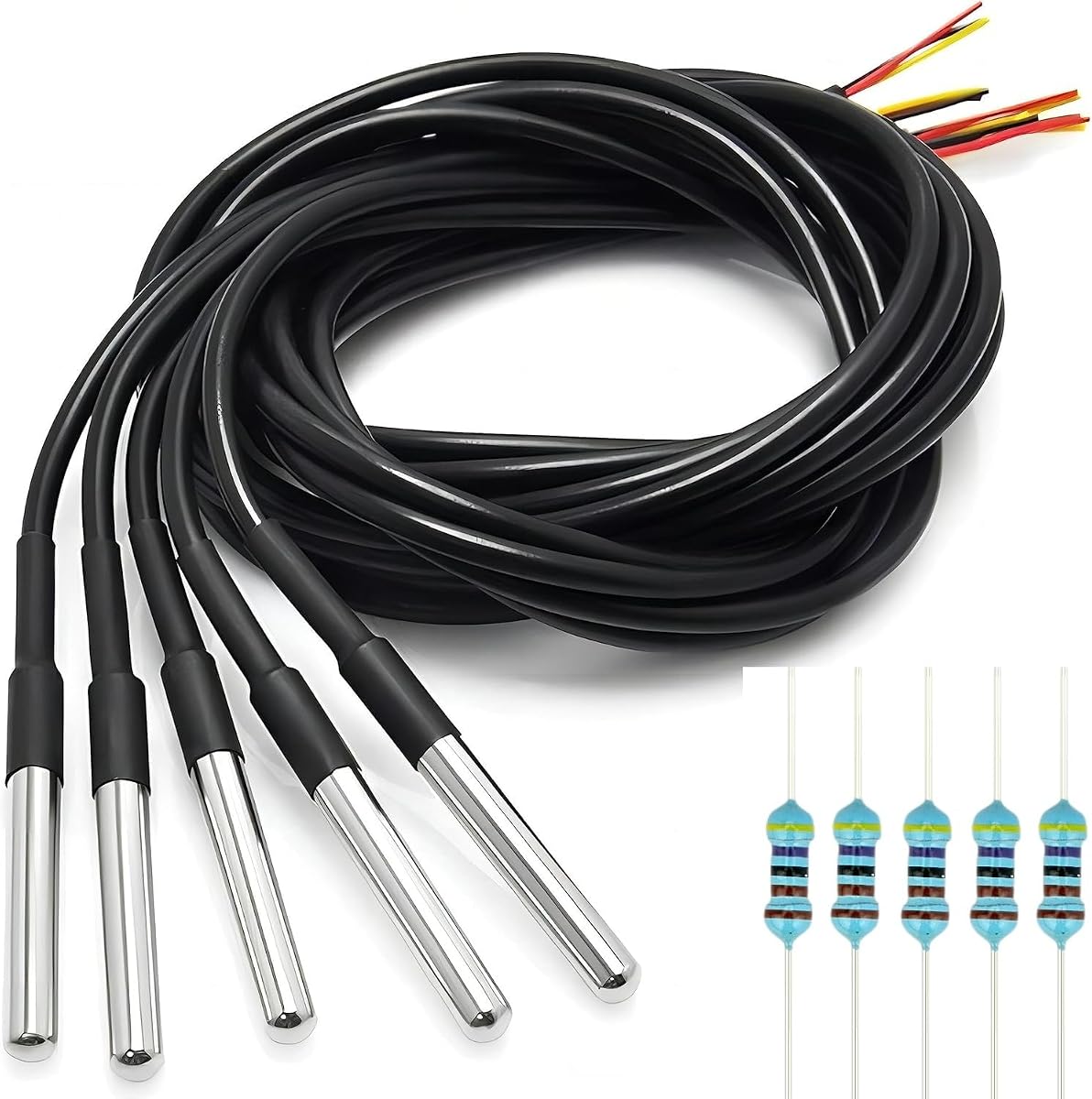
The WWZMDiB pack offers five waterproof probes along with the necessary resistors to get started immediately. This value pack is designed for DIY projects where you need multiple sensors without paying for premium branding or extra accessories.
We may earn a commission when you buy through this link, at no additional cost to you.
The waterproof probe is designed for underwater use so it can operate in wet environments without damage. With a wide temperature range of minus 55 to 125 degrees Celsius it is suitable for almost any general purpose monitoring task.
Although it lacks adapter boards the wiring is straightforward and well documented by users. The high accuracy ensures that your readings are reliable for scientific experiments or hobbyist applications requiring consistent data.
If you need multiple sensors for a large project this pack is an excellent choice. The inclusion of resistors means you do not need to buy extra components separately saving you time and money.
Getting five sensors allows you to monitor temperature at multiple points in your setup with a single purchase.
The inclusion of resistors ensures you have everything needed to complete the circuit without additional purchases.
We may earn a commission when you buy through this link, at no additional cost to you.
This pack provides two complete modules with wires ready for immediate use. It is designed for beginners who want a straightforward way to start measuring temperature and humidity without worrying about complex assembly.
We may earn a commission when you buy through this link, at no additional cost to you.
The dedicated digital modules ensure high reliability and excellent long term stability for your projects. The simple communication protocol reduces programming effort allowing you to focus on the rest of your build.
While the accuracy is not as high as newer sensors it is sufficient for general household or hobbyist use. Users find the included wires helpful as they save time on soldering or cutting additional cables for connections.
This sensor is ideal for simple weather stations or room monitoring. If you need a quick solution that is easy to set up and reliable for basic tasks this pack serves well.
The inclusion of wires means you can connect the sensor to your board immediately without additional tools.
The simple communication protocol ensures that writing code to read the sensor is straightforward and quick.
We may earn a commission when you buy through this link, at no additional cost to you.
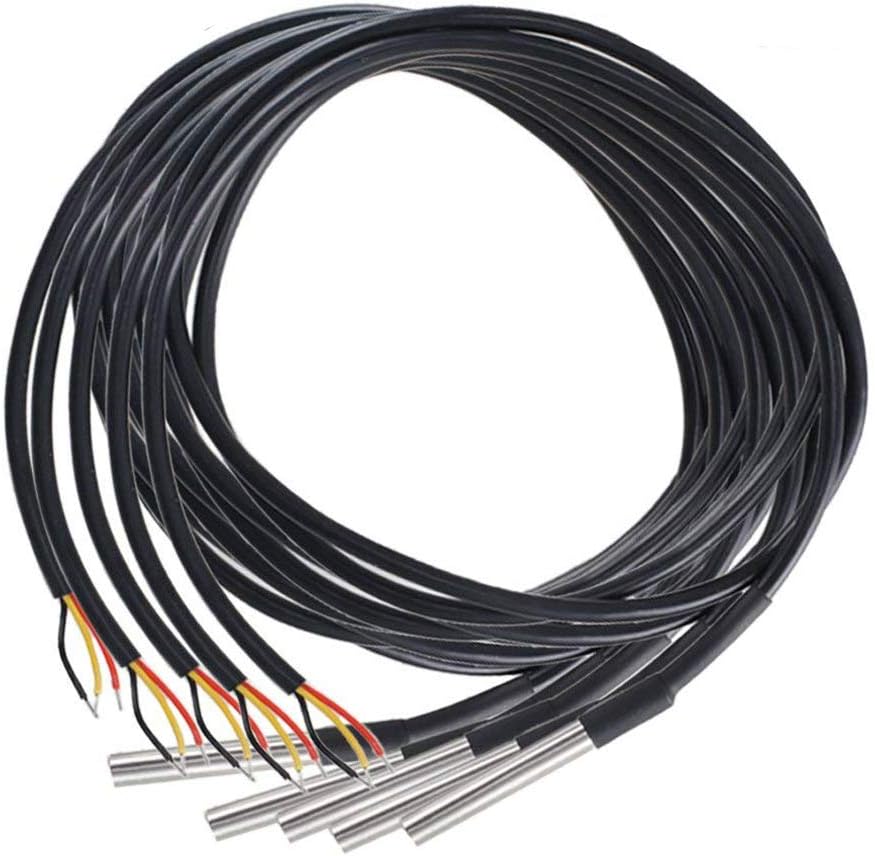
The Gikfun 5PCS set provides a bulk option for those needing multiple waterproof sensors. Each probe comes with a one meter cable which offers significant flexibility in where you can place the sensor relative to the controller.
We may earn a commission when you buy through this link, at no additional cost to you.
The single bus interface is unique and allows you to connect multiple probes on a single data line. This reduces the pin count on your Arduino and simplifies the wiring when you have many sensors to deploy across a large area.
While it does not include adapters users appreciate the straightforward wiring and the ability to customize the setup. The wide voltage range ensures compatibility with most common power sources used in DIY electronics projects.
This set is perfect for monitoring temperature in large greenhouses or industrial setups. Having five waterproof units allows you to cover multiple zones without worrying about moisture damaging your sensors.
The single bus interface allows you to daisy chain multiple probes reducing wiring complexity significantly.
The one meter cable provides enough length to reach most areas without needing extension cables.
We may earn a commission when you buy through this link, at no additional cost to you.
The DHT22 module is an upgraded version of the classic DHT11 offering better accuracy and a wider temperature range. It is perfect for projects that require more reliable data without moving to a premium industrial sensor.
We may earn a commission when you buy through this link, at no additional cost to you.
It features the AM2302 chip which provides high sensitivity and precise readings. The bidirectional serial data ensures that the communication between the sensor and microcontroller is robust and less prone to errors during operation.
With fixing screw holes it is easy to install and fix securely in your enclosure. Users appreciate the ability to track humidity changes with higher accuracy which is vital for many home automation and weather projects.
This sensor is ideal for smart home devices or weather stations. If you need better performance than the basic DHT11 but still want an easy to use digital sensor this is the best upgrade option.
The wider temperature range and higher sensitivity ensure accurate data even in challenging environments.
The fixing screw holes allow you to mount the sensor securely to prevent movement or vibration issues.
We may earn a commission when you buy through this link, at no additional cost to you.
The HiLetgo 5pcs DS18B20 set provides a durable stainless steel package for your temperature probes. This makes it a reliable choice for industrial applications or environments where physical damage to the sensor is a risk.
We may earn a commission when you buy through this link, at no additional cost to you.
The waterproof probe ensures that the internal electronics are protected from moisture. With a wide temperature range of minus 55 to 125 degrees it is suitable for a variety of demanding conditions and harsh environments.
While it lacks an adapter board the single bus interface and standard wiring make it compatible with most setups. Users appreciate the stainless steel protection which adds a layer of physical security to the sensor.
This set is perfect for outdoor or industrial monitoring where durability is key. If you need five waterproof sensors with robust protection this option delivers reliability and longevity.
The stainless steel packaging adds physical durability so the sensor survives rough handling better than plastic models.
The waterproof probe design ensures that rain or humidity does not interfere with accurate temperature readings.
We may earn a commission when you buy through this link, at no additional cost to you.
Choosing the right temperature sensor requires evaluating factors like accuracy range interface and environmental durability to match your project needs.
Accuracy determines how close the reading is to the true temperature. High precision sensors like the SHT31 or AHT30 offer accuracy within 0.3 degrees Celsius which is crucial for scientific or controlled climate projects.
For basic hobby projects a wider margin like 2 degrees is often acceptable. Always check the specification to ensure the sensor meets the tolerance requirements of your specific application.
Different sensors support different operating ranges. The DS18B20 is robust with a range from minus 55 to 125 degrees while the DHT11 is limited to 0 to 50 degrees Celsius.
Ensure your chosen sensor can handle the extremes of your environment. If you are measuring outdoor weather or industrial machinery pick a model with a wider range to avoid failure.
The interface determines how the sensor connects to your Arduino. I2C is great for multiple sensors with just two wires while 1-Wire is excellent for long distance or multiple devices on one pin.
Digital protocols like those used by DHT sensors simplify coding by providing calibrated output. Consider your pin availability and wiring complexity when selecting the interface type for your project.
If your sensor will be exposed to moisture or harsh conditions waterproof probes are essential. Stainless steel probes offer physical protection against corrosion and impact which extends the life of the device.
Look for models specifically labeled as waterproof or designed for submersion. Ensure that the probe can withstand the temperature extremes it will face while submerged or exposed.
Low power sensors are vital for battery operated projects. Sensors like the AHT30 have low power consumption ensuring your project runs longer on a single charge or battery.
Check the supply voltage range to ensure it matches your power source. Most sensors operate between 3.3V and 5.5V but some are more efficient at lower voltages than others.
Some sensors come with adapter boards and resistors which simplify setup. This is particularly helpful for beginners who might not have the extra components to complete the circuit.
Pre-calibrated sensors reduce the need for complex code or external calibration. Choose a model with good library support to save time on programming and debugging your project.
Consider the cost relative to the features you need. Buying in bulk can save money if you need multiple units but ensure the quality meets your standards.
Premium models offer better durability and accuracy but may be overkill for simple tasks. Balance your budget with the performance requirements of your specific application to get the best value.
Some sensors like the DHT11 and SHT31 also measure humidity alongside temperature. This dual functionality is useful for environmental monitoring where both factors affect comfort or safety.
If you only need temperature a single function sensor might be more cost effective. Ensure that humidity accuracy meets your needs if you are tracking moisture levels.
Install the sensor according to the wiring diagram provided. For 1-Wire sensors ensure you use the correct pull-up resistor between the data pin and power pin to maintain signal stability.
Secure the sensor in a location away from direct heat sources or sunlight to ensure accurate readings. Proper placement prevents external factors from influencing the temperature data collected.
Keep the sensor clean and free from dust or debris that could insulate the reading. If using a waterproof probe ensure seals are intact to prevent moisture from damaging the internal circuitry.
The DHT11 is widely considered the best starting point for beginners due to its simplicity and availability. It is easy to wire and has extensive library support making it a reliable choice for first projects.
Waterproof sensors are not strictly necessary for indoor use but they add durability. If you expect high humidity or accidental spills a waterproof probe can extend the lifespan of your hardware.
Most digital sensors come pre-calibrated and do not require manual calibration. If you notice a consistent offset you can adjust the readings in your software code rather than changing the hardware.
Yes you can connect multiple sensors using interfaces like I2C or 1-Wire. These protocols allow you to chain devices on the same data lines saving valuable pins on your microcontroller.
Most temperature sensors operate on a voltage between 3.3V and 5.5V. Always check the datasheet to ensure compatibility with your specific Arduino board power supply.
With proper care temperature sensors can last for years. The electronic components are durable but the probe may degrade over time if exposed to extreme environmental conditions continuously.
We have reviewed ten top options ranging from budget-friendly DHT modules to premium waterproof probes. The SHT31-D stands out for accuracy while the AHT30 offers great value for beginners.
Prioritize factors like range and waterproofing based on your specific project needs. Choosing the right sensor will ensure your data is reliable and your project performs as expected.
Always check current prices and availability before purchasing as these change frequently. We hope this guide helps you find the perfect temperature sensor for your next Arduino build.