
QNAP TL-D1600S
4.5Editor score
SATA 6Gbps JBOD support
Includes PCIe SATA card
Flexible 3.5 and 2.5 inch
Finding the right storage solution for large data volumes requires careful consideration of capacity, speed, and reliability. A 16 bay NAS enclosure offers the perfect balance for growing businesses and power users needing extensive file management capabilities.
We have evaluated ten top-rated products based on their build quality, connectivity options, and overall performance metrics. Our analysis focuses on how well each unit handles heavy workloads and integrates into existing network infrastructures effectively.
Each selection highlights specific strengths such as drive compatibility, cooling efficiency, and expansion potential. Please note that product availability and pricing fluctuate regularly, so verify current details before making your final purchasing decision today.
4.5Editor score
4.5Editor score

4.6Editor score
As an Amazon Associate we earn from qualifying purchases.
The following table provides a side-by-side comparison of the ten selected enclosures highlighting their key specifications and unique features for easy reference during your evaluation process.


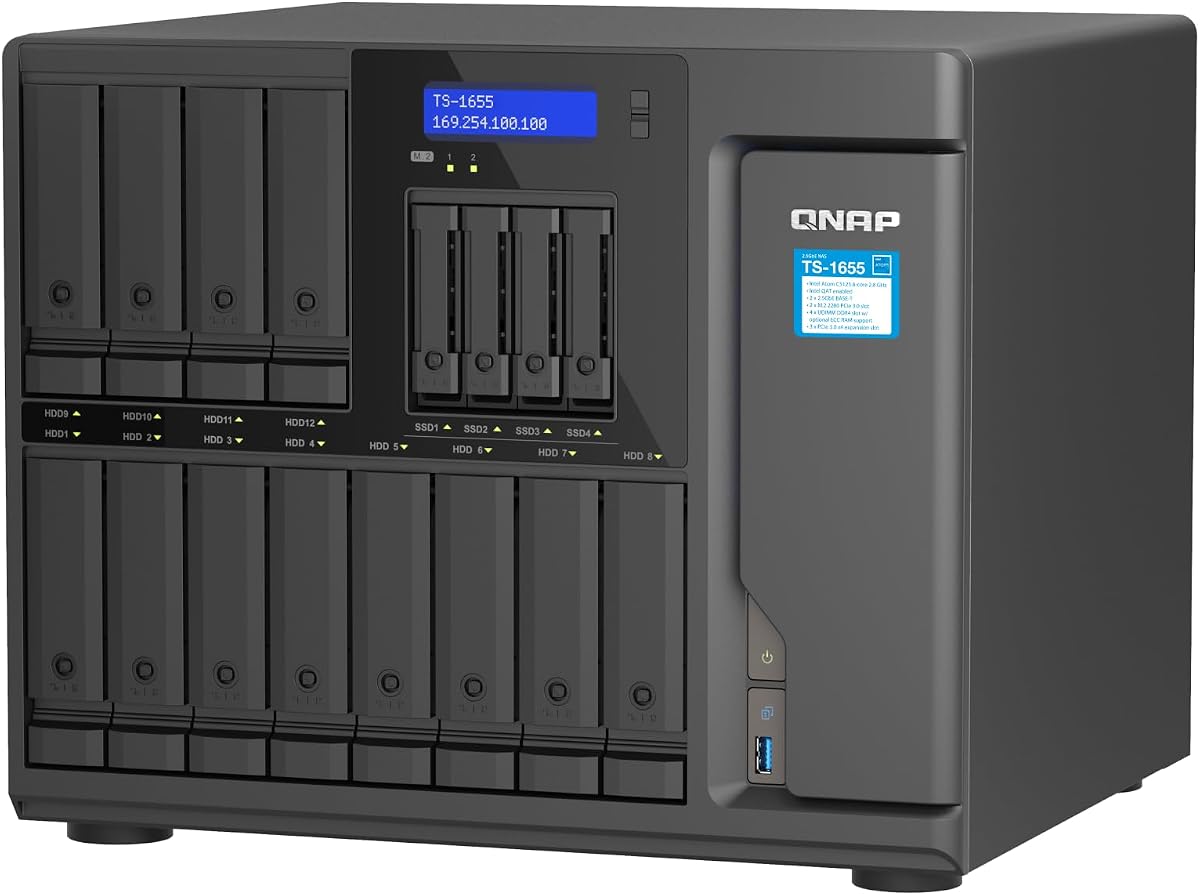
The QNAP TS-1655-8G-US stands out as a powerful hybrid NAS solution offering significant flexibility for modern storage needs. With its Intel Atom processor and ample RAM support it handles complex virtualization tasks with ease.
We may earn a commission when you buy through this link, at no additional cost to you.
Its dual M.2 NVMe slots provide critical cache acceleration that boosts overall system responsiveness especially when managing large media libraries or databases. The inclusion of dual 2.5GbE ports ensures your network bottleneck does not limit your storage speed.
While the unit is highly capable users should note that the cooling system can produce noticeable noise under heavy loads. Additionally proper configuration is required to unlock the full potential of its expansion capabilities and ECC memory support.
This model is ideal for small businesses or enthusiasts who need a balance between performance and storage density. Its long term availability and upgrade path make it a solid investment for future growth.
The high RAM ceiling allows multiple virtual machines to run smoothly without performance degradation.
Dedicated NVMe slots enable faster read/write speeds for frequently accessed data sets.
We may earn a commission when you buy through this link, at no additional cost to you.
The Synology RS4021xs+ is a top-tier rackmount solution designed for demanding enterprise environments that require reliability and speed. Its 8-core processor ensures that compute-intensive services run without interruption even during peak usage times.
We may earn a commission when you buy through this link, at no additional cost to you.
One of its strongest features is the ability to scale up to 40 drive bays using RX1217 expansion units which provides immense flexibility for growing data centers. The dual PCIe slots allow for network upgrades or SSD cache expansion to boost performance further.
The price is significantly higher than consumer options but the build quality and feature set justify the investment for mission-critical operations. Users should be prepared for a professional installation process and potentially higher energy consumption.
This unit is best suited for IT departments managing critical backups or video management systems. The robust warranty and Synology support network add peace of mind for long-term deployments.
Expansion to 40 bays allows for petabyte-level storage without changing the base unit.
Redundant power supplies ensure uptime even if one power source fails unexpectedly.
We may earn a commission when you buy through this link, at no additional cost to you.
The QNAP TL-D1600S offers an affordable way to expand storage for existing QNAP or compatible systems without needing a full new NAS. It is a pure JBOD enclosure that adds raw capacity efficiently to your setup.
We may earn a commission when you buy through this link, at no additional cost to you.
Included in the box is a PCIe SATA interface card which saves additional cost and ensures compatibility with the enclosure. It supports both 3.5 and 2.5 inch drives allowing you to mix HDDs and SSDs for varied storage needs.
Because it lacks its own processing unit it depends entirely on your host NAS for management and control. This makes it less standalone but highly effective for users who already own a compatible NAS device.
This is an excellent choice for those looking to add bulk storage quickly and cheaply. Its desktop-friendly design means it can fit in an office environment without requiring a dedicated server rack.
Adding drives here is cheaper than upgrading to a larger all-in-one NAS unit.
The included PCIe card ensures immediate connectivity without extra purchases.
We may earn a commission when you buy through this link, at no additional cost to you.
The Generic ZhenLoong tower is a chassis designed for those who want to build a custom NAS server from scratch. It supports up to 15 drives and offers significant flexibility in terms of motherboard and power supply selection.
We may earn a commission when you buy through this link, at no additional cost to you.
Hot swap capabilities mean you can replace drives without shutting down the system which is crucial for 24/7 operation. The chassis also accommodates large GPUs which makes it versatile for AI or media transcoding tasks.
Assembly is required which means you must purchase a motherboard power supply and drives separately. The long shipping window from overseas can be a drawback for those needing immediate delivery of the unit.
This option is best for DIY enthusiasts who enjoy building custom systems. The sheer number of expansion slots and support for redundant power supplies make it a robust foundation for a high-end home lab.
Support for EEB and EATX boards allows for powerful server grade component choices.
The spacious interior allows installation of large graphics cards for specialized workloads.
We may earn a commission when you buy through this link, at no additional cost to you.
The Asustor Lockerstor 10 is designed for enthusiasts who need ultra-fast network connectivity to match their storage speeds. Its dual 10GbE ports allow for massive bandwidth aggregation that supports multiple simultaneous users efficiently.
We may earn a commission when you buy through this link, at no additional cost to you.
ECC DDR5 memory ensures data integrity which is vital for business critical workloads and virtualization. The inclusion of USB4 ports provides an additional layer of high-speed external connectivity for professional workflows.
While it has fewer drive bays than others on this list the raw speed of its connectivity makes it stand out for media editing. However the mix of 10GbE and 5GbE ports might require careful network planning to utilize fully.
This device is perfect for media studios or tech savvy users needing fast throughput. Its optimization for 4K and 8K workflows makes it a strong contender for creative professionals.
Dual 10GbE ports provide the speed needed for direct video editing from NAS.
DDR5 support offers better efficiency and performance than older DDR4 systems.
We may earn a commission when you buy through this link, at no additional cost to you.
The Synology DX1222 is a dedicated expansion unit that integrates seamlessly with selected Synology diskstation units to add more storage. It simplifies the process of scaling up without moving to a larger expensive server.
We may earn a commission when you buy through this link, at no additional cost to you.
Configuration is handled through Synology DSM tools which makes managing the new drives straightforward even for less experienced users. The unit comes with a five year warranty ensuring long term reliability for your data.
It is important to note that this unit must match compatible Synology host models to function correctly. This dependency ensures stability but limits its use to those already invested in the Synology ecosystem.
This expansion unit is ideal for growing offices that need more space quickly. Its plug and play nature reduces downtime and administrative overhead significantly during installation.
DSM tools allow you to treat expansion drives as part of the main storage pool.
Adding capacity in steps avoids the need to replace the entire storage system.
We may earn a commission when you buy through this link, at no additional cost to you.
The Synology DS3622xs+ combines strong hardware with an intuitive software ecosystem making it a popular choice for businesses. Its 6-core Intel Xeon processor handles virtualization and heavy file transfers with high efficiency.
We may earn a commission when you buy through this link, at no additional cost to you.
You can expand to 36 bays using DX1222 units which gives you plenty of room to grow. NVMe SSD Cache support allows you to speed up read write operations for critical applications without changing the main storage.
The setup process can be complex for beginners but the end result is a highly capable system. The software support provides a wealth of tools for backup monitoring and file sharing out of the box.
This unit is well suited for small to medium businesses needing a centralized storage and backup server. Its versatility and expansion potential make it a future-proof option for evolving needs.
NVMe cache allows you to fine-tune performance for specific high-speed tasks.
Deep integration with backup and video management tools simplifies daily tasks.
We may earn a commission when you buy through this link, at no additional cost to you.
The QNAP TL-R1600PES is designed for environments where rack space is limited but capacity is critical. Its short depth design makes it easy to fit into smaller cabinets or crowded server rooms without compromising on drive count.
We may earn a commission when you buy through this link, at no additional cost to you.
It supports 16 drives with SATA 6Gb/s speeds ensuring fast data transfer for bulk storage. The redundant power supplies add a layer of safety against power failures which is essential for always-on services.
Cabling can be specific due to the Mini-SAS HD ports requiring proper cables for connection. Installation requires basic rack skills but the unit is built to integrate smoothly into professional setups.
This is an ideal choice for media centers or small server rooms needing dense storage. The balance of depth and capacity solves common space constraints effectively.
Short depth allows placement in tight spaces where standard racks won't fit.
Two power supplies ensure the drives stay online if one fails unexpectedly.
We may earn a commission when you buy through this link, at no additional cost to you.
The CENMATE Aluminum enclosure is a direct attached storage solution that offers high capacity without the need for a network server. It supports both 2.5 and 3.5 inch drives providing flexibility for different drive types.
We may earn a commission when you buy through this link, at no additional cost to you.
Tool-free hot swapping makes it easy to add or remove drives as needed which is great for archiving workflows. The aluminum construction helps dissipate heat effectively though the fans can be noticeable when running.
Since it lacks RAID features data redundancy must be handled by the host system. This simplicity keeps the unit affordable and easy to use for personal or enterprise external storage needs.
This unit is perfect for those needing a massive portable storage block without network complexity. It serves well for backing up large video projects or media libraries directly to a computer.
USB 3.0 allows fast direct connections without configuring a network server.
Daisy chaining allows you to add more enclosures for even larger storage pools.
We may earn a commission when you buy through this link, at no additional cost to you.
This hybrid NAS combines high performance processing with substantial storage capacity in a single package. It is designed to handle intensive tasks like virtualization while providing massive storage for data archiving.
We may earn a commission when you buy through this link, at no additional cost to you.
M.2 NVMe slots allow for SSD caching which improves the speed of accessing frequently used files. The dual 2.5GbE network ports ensure your data transfer rates keep up with the system's processing speed.
Long term availability means this model will be supported with firmware updates for a long time. This makes it a safer investment for businesses that need stable hardware without frequent replacements.
It is suitable for users who need both speed and capacity in one device. The balance of features makes it a versatile option for small offices and advanced home users alike.
Combining SSD cache with large HDD capacity gives the best of both worlds.
The 8-core Atom processor ensures smooth multitasking across various services.
We may earn a commission when you buy through this link, at no additional cost to you.
Selecting the right 16 bay NAS enclosure depends on several critical factors that impact your storage performance and scalability. This guide breaks down what to consider before purchasing to ensure you get the best fit.
Verify that the enclosure supports the physical size and type of drives you plan to use such as 3.5 inch or 2.5 inch. Most 16 bay units support mixed sizes but checking the maximum capacity per drive is essential for planning future growth.
Ensure the total capacity matches your current needs and leaves room for expansion over time without requiring a complete hardware swap.
Look for enclosures with fast interface options like SATA 6Gb/s or Mini-SAS HD to prevent bottlenecks during large file transfers. USB 3.0 or higher is preferred for DAS units while NAS should have Gigabit or 10GbE ports.
High speed connectivity ensures your network bandwidth is not a limiting factor when multiple users access data simultaneously.
With 16 drives running heat build-up can be a major issue so adequate cooling is mandatory. Check for models with multiple high quality fans and solid ventilation design to keep drives at safe operating temperatures.
Proper thermal management extends the lifespan of your drives and prevents data loss due to overheating in enclosed spaces.
For professional environments consider units with redundant power supplies to maintain uptime during power outages or failures. A backup power source prevents sudden shutdowns that could corrupt data or damage hardware.
Redundant power is a small cost for added reliability especially when storing critical business or personal data.
Choose a system that allows you to add more bays or upgrade internal components like RAM and cache slots as your needs grow. Look for PCIe slots or expansion ports that support future additions.
Scalability protects your investment by allowing gradual upgrades instead of replacing the entire unit when storage limits are reached.
Tool-free drive trays and clear interface layouts simplify maintenance and daily use significantly. For NAS systems intuitive management software makes it easier to configure and monitor the drives.
A user-friendly setup reduces administrative time and frustration especially when swapping out drives or diagnosing issues.
A solid warranty period indicates manufacturer confidence in product quality and provides protection against defects. Look for brands offering at least three to five years of coverage for peace of mind.
Reliable technical support ensures you can get help quickly if hardware issues arise during critical operations.
Compare prices against the feature set to ensure you are paying for capabilities you actually need. A cheaper unit may lack redundancy or speed while a premium one might offer features you do not use.
Value is found in balancing performance durability and price to suit your specific workload and budget constraints.
Start by installing drives one at a time ensuring each is recognized by the system before adding the next. Use a cable management system to organize power and data lines for better airflow and easier troubleshooting.
Regularly check firmware updates and security patches to keep your NAS running securely and efficiently. Monitor drive health through included software tools to detect early signs of failure before data is lost.
Keep the unit in a cool dry location away from direct sunlight or dust accumulation. Periodically clean dust from intake fans and vents to maintain optimal cooling performance and extend hardware life.
Yes most enclosures listed are diskless meaning you must purchase hard drives separately. This allows you to choose specific capacities and brands that suit your performance and reliability requirements.
Most 16 bay enclosures support both 3.5 inch and 2.5 inch drives simultaneously. However you should check the specific model's compatibility to ensure all drive trays accommodate mixed sizes correctly.
NAS units typically support RAID configurations through their operating system while DAS enclosures usually do not. Check the product specifications to confirm if RAID is supported if that is a requirement for your setup.
Many models support expansion units that daisy chain to the main enclosure adding more drive capacity. This allows you to scale up to 32 or 48 bays without replacing the core system.
Most NAS and DAS enclosures support Windows Mac and Linux systems via standard protocols. Confirm the specific software compatibility for your operating system before purchasing to ensure seamless integration.
High capacity enclosures often run fans which can generate noise. Consider the decibel rating and fan control options if placing the unit in a living space or quiet office environment.
Our top picks highlight the best options available for different needs ranging from enterprise grade rackstations to budget friendly expansion units. Whether you need raw capacity or advanced processing power there is a model that fits.
Prioritize factors like cooling reliability and scalability to ensure your storage solution grows with you over time. Investing in a robust enclosure now can prevent costly upgrades and downtime later.
Always check current availability and pricing as these details can change quickly due to market demand. Comparing specs and features carefully will help you make the most informed decision for your data needs.