
ESP8266 ESP-01S
4.4Editor score
Compact 4MB Flash Memory
Strong Signal Strength
Low Power Consumption
This guide compares the top ten Arduino WiFi modules for 2026, evaluating connectivity, processing power, and ease of use for your next embedded project.
Arduino WiFi modules enable seamless wireless connectivity for your embedded projects. Choosing the right one involves balancing processing power, range, and compatibility with your existing hardware setup.
We evaluated ten top-rated options based on connectivity standards, memory capacity, and community support. Our analysis ensures you find a module that fits both beginner and advanced development needs.
Each pick highlights key strengths and potential trade-offs to help you decide. Note that availability and pricing may fluctuate over time so check current listings before purchasing.
4.4Editor score

4.7Editor score

4.7Editor score
The following table offers a side-by-side comparison of all ten selected WiFi modules. Reviewing key specifications helps you quickly identify the most suitable option for your specific application requirements.



The Arduino UNO R4 WiFi stands out as a top-tier choice for developers seeking advanced capabilities. It combines the Renesas RA4M1 microcontroller with the ESP32-S3 chip for powerful dual-core processing.
We may earn a commission when you buy through this link, at no additional cost to you.
Its comprehensive wireless connectivity includes both Wi-Fi and Bluetooth 5.0. This ensures stable communication for IoT projects. The modern USB-C port improves power delivery and programming speed significantly.
While powerful, it may have a steeper learning curve for beginners compared to classic boards. However, the integrated features like the LED matrix and 12-bit DAC justify the complexity for serious projects.
If you need a versatile board for industrial or advanced embedded applications this is the ideal choice. Its feature set covers almost every requirement a modern IoT developer could ask for.
The combination of Renesas RA4M1 and ESP32-S3 allows for high-speed communications and real-time data processing simultaneously.
The built-in 12×8 LED Matrix enables immediate visual feedback for status indicators and interactive user interfaces.
We may earn a commission when you buy through this link, at no additional cost to you.
This pack offers three ESP8266 modules which is excellent for prototyping multiple devices. The ESP8266 provides robust on-board processing capabilities for simple wireless tasks.
We may earn a commission when you buy through this link, at no additional cost to you.
It supports three modes including AP and STA which gives flexibility for different networking scenarios. Compatibility with Arduino makes integration straightforward for existing projects.
Users should ensure adequate power supply as these modules can draw significant current during transmission. Documentation is minimal so online resources are often necessary for setup.
For budget-conscious developers needing multiple wireless nodes this pack is highly recommended. It balances cost and functionality effectively for entry-level IoT experimentation.
Support for AP and STA modes allows you to connect to networks or create your own access points easily.
Getting three modules in one pack reduces the cost per unit significantly for larger projects.
We may earn a commission when you buy through this link, at no additional cost to you.
The ESP8266 ESP-01S is a compact module known for its reliability and low cost. It features 4MB of flash memory which is ample for storing application data.
We may earn a commission when you buy through this link, at no additional cost to you.
Being the latest version it offers stronger signal transmission compared to older models. You need to select the Generic ESP8266 Module in the IDE to program it correctly.
It lacks built-in level shifters so voltage regulation is crucial to prevent damage. Using an external USB-TTL converter is necessary to interface it with a computer.
If cost is your primary concern this module delivers excellent performance. Its simplicity makes it perfect for dedicated wireless tasks within a larger system.
The latest version s variant provides stronger signal strength ensuring better connectivity in noisy environments.
With 4MB flash you can store larger scripts and assets directly on the module without external storage.
We may earn a commission when you buy through this link, at no additional cost to you.
This pack includes five ESP8266 modules suitable for widespread deployment in smart grids or transportation. It supports AP and STA modes for flexible networking configurations.
We may earn a commission when you buy through this link, at no additional cost to you.
The modules are designed for 3.3V operation ensuring you must not exceed this voltage during use. They are ready for Arduino and NodeMCU frameworks out of the box.
I/O voltage tolerance is limited to 3.6V max which restricts integration with 5V systems directly. Adequate level shifting is required for safe interfacing with standard microcontrollers.
If you need multiple units for distributed sensor networks this pack offers great value. Its reliability and low cost make it a staple for industrial prototyping.
These modules are widely used in industrial control and smart grids due to their robust connectivity.
Users must strictly adhere to 3.3V power sources to avoid damaging the module.
We may earn a commission when you buy through this link, at no additional cost to you.
This bundle provides three ESP-32 boards delivering up to 240 MHz dual-core performance for complex tasks. Built-in Wi-Fi and Bluetooth enable versatile wireless device connectivity options.
We may earn a commission when you buy through this link, at no additional cost to you.
USB-C programming offers efficient power delivery and stable connections for uploading sketches. OTA support allows you to update deployed firmware over Wi-Fi without physical access.
The included USB-C cable is missing which means you must provide your own for development. Additionally, power consumption is higher than the ESP8266 series for intensive tasks.
Developers needing processing power and remote update capabilities will love this option. The multi-pack ensures you have backups for different stages of production testing.
OTA functionality helps you maintain devices in the field without needing physical reconnection.
Running wireless tasks on one core and logic on another improves overall system responsiveness.
We may earn a commission when you buy through this link, at no additional cost to you.
Powered by the ESP32-S3 chip this board offers 240 MHz processing for machine learning and IoT. MicroPython compatibility allows developers to prototype faster without writing complex C++.
We may earn a commission when you buy through this link, at no additional cost to you.
It features USB-C for efficient power and programming stability. HID support enables custom input devices like keyboards or mice easily using the board.
Headers are not included which may delay immediate prototyping unless you solder them yourself. Tooling is specific so ensure your IDE supports MicroPython correctly.
For Python enthusiasts needing a modern embedded platform this board is ideal. Its flexibility supports rapid iteration for custom interfaces and smart sensors.
HID profiles allow you to build your own USB input peripherals for specialized interfaces.
MicroPython support simplifies coding tasks making embedded development accessible to software engineers.
We may earn a commission when you buy through this link, at no additional cost to you.
This pack provides four reliable modules ideal for wearable electronics or sensor networks. The self-calibrated RF ensures optimal performance for wireless location sensing devices.
We may earn a commission when you buy through this link, at no additional cost to you.
Constructed with good material the modules can be reused multiple times. This longevity makes them suitable for long-term home automation prototypes.
Documentation may be minimal so you might rely on community forums for troubleshooting. Lack of level shifters requires careful voltage management during soldering.
If you are building a smart home project needing multiple nodes this pack is reliable. Its quality ensures stable connections for sensors and actuators.
These modules excel in location sensing scenarios due to their consistent signal quality.
The durable build allows you to reuse modules across different prototypes effectively.
We may earn a commission when you buy through this link, at no additional cost to you.
These modules offer 4MB flash which is substantial for storing large data or code. They operate at 115200 baud rate providing fast serial communication for IoT tasks.
We may earn a commission when you buy through this link, at no additional cost to you.
You must use the SPI DOUT protocol when programming them in the IDE. Selecting the Generic ESP8266 board ensures correct compatibility with Arduino setup.
Using 5V will damage the unit so you must ensure 3.3V power. Protocol confusion can lead to flashing errors if settings are incorrect.
Developers needing extra storage for data logging will appreciate this choice. It strikes a balance between capacity and price effectively.
With 4MB flash you can store substantial amounts of sensor data before transmission.
Using SPI DOUT mode prevents programming errors and ensures stable boot sequences.
We may earn a commission when you buy through this link, at no additional cost to you.
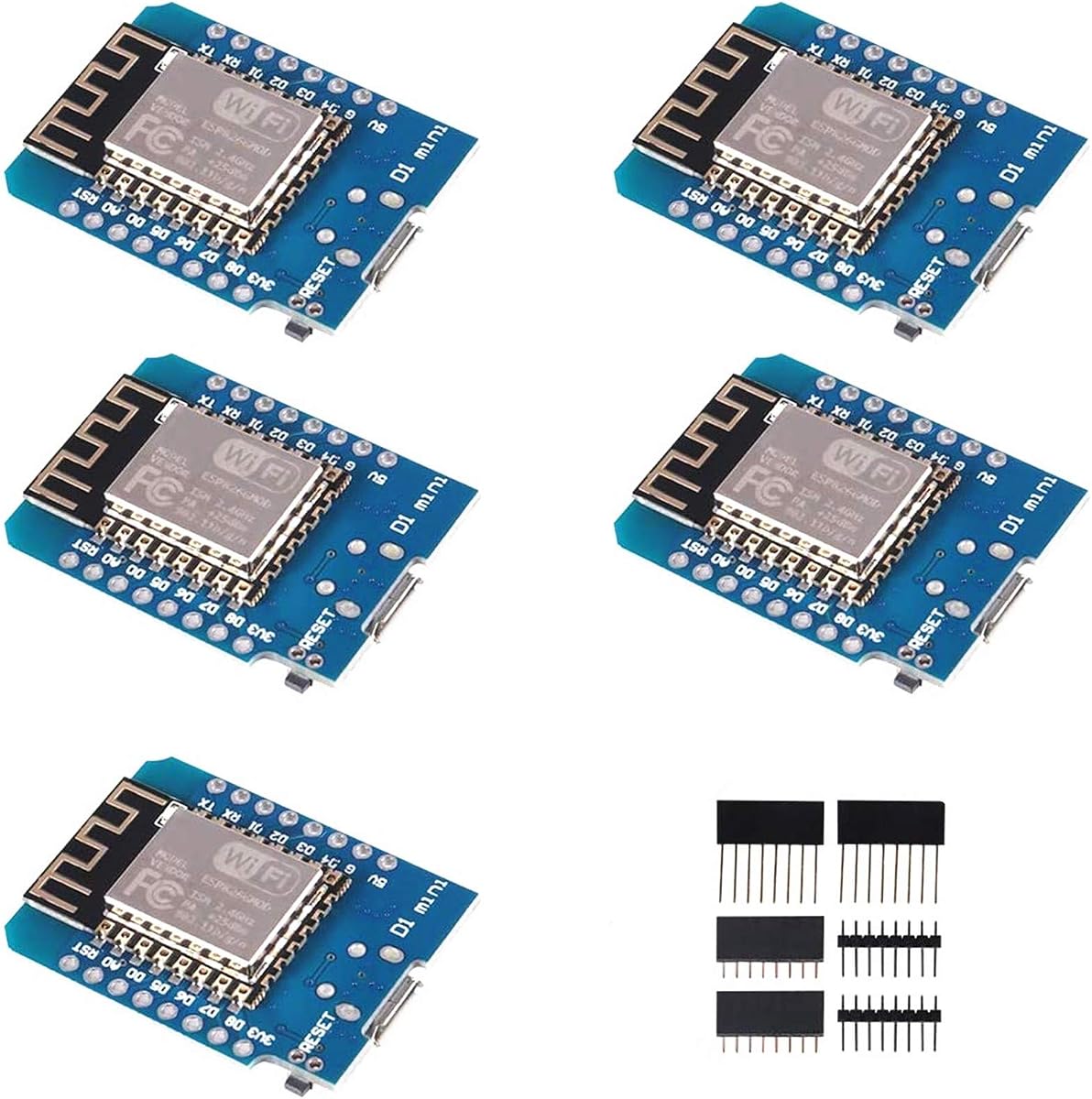
The D1 mini is a compact development board based on ESP-8266EX. It provides 11 digital input output pins with PWM and interrupt support for versatile control.
We may earn a commission when you buy through this link, at no additional cost to you.
It features a 5V 1A switching power supply onboard making it easy to power via Micro USB. The board is compatible with Arduino WeMos and Lua programming.
The Micro USB connector may be less durable than Type-C. The small size makes it great for wearable devices but harder to handle during soldering.
Wearable electronics designers will find this module ideal for its size. It offers extensive I/O options in a very compact package.
The small footprint allows this module to fit inside tight wearable device cases easily.
Having many pins supports complex projects needing multiple sensors and actuators.
We may earn a commission when you buy through this link, at no additional cost to you.
This pack includes ten modules providing ample on-board storage and processing for complex algorithms. It supports AP and STA modes for versatile networking options for diverse applications.
We may earn a commission when you buy through this link, at no additional cost to you.
Arduino synergy is strong here as the modules are fully compatible with Arduino platforms and LWIP. The large quantity makes it perfect for bulk prototyping or testing.
Managing ten units requires good organization. The build is basic but functional for most standard wireless tasks.
If you need a large quantity for industrial testing or production this pack is unmatched. It offers high value for large scale deployments.
Ten modules allow you to test multiple nodes simultaneously in a network environment.
The robust processing power handles complex tasks and algorithms efficiently.
We may earn a commission when you buy through this link, at no additional cost to you.
Selecting the right WiFi module depends on your project's power budget, data requirements, and connectivity needs.
Dual-core modules like the ESP32 offer faster data processing compared to single-core ESP8266. Consider your logic complexity before choosing.
Prioritize high processing speeds for complex data or machine learning tasks.
Modern modules support Bluetooth 5.0 for improved range and low energy. Older versions may limit device pairing.
Ensure the module supports Bluetooth version for your specific hardware requirements.
Flash memory varies from 1MB to 4MB. Larger capacity helps store extensive logs or scripts.
Choose 4MB modules if you need to store significant data locally.
Battery-powered projects need efficient sleep modes. ESP32 offers dynamic clock scaling to save power.
Look for low-power modes if you are designing a battery-powered device.
Modern boards use USB-C for easier cable management. Older modules may require adapters.
Prefer USB-C for future-proofing and compatibility with new laptops.
Most WiFi modules run at 3.3V. Connecting directly to 5V can damage the chip.
Always use level shifters or regulators if your board outputs 5V.
Modules with popular platforms like Arduino and NodeMCU have more tutorials. Limited support slows development.
Choose widely supported chips to ensure you find help online.
Smaller modules are better for wearables. Larger boards offer built-in headers.
Consider your physical space constraints before selecting a module.
Always start by checking the voltage requirements. Never connect the module directly to a 5V pin if it is 3.3V only.
Use a stable power source to prevent resets. WiFi modules draw high current during transmission which can cause brownouts.
Keep your code updated and test firmware regularly. Clear cache or use OTA updates to ensure smooth operation.
No, the ESP8266 operates at 3.3V. You must use a voltage divider or level shifter on the RX pin to connect it safely to a 5V Arduino.
AP mode makes the module an access point connecting to devices. STA mode connects the module to an existing WiFi network for internet access.
Common causes include power instability, poor signal, or high current draw. Ensure you use a stable 5V supply with adequate capacity.
Install the ESP32 board support in the Arduino IDE. Select the correct board type and port then upload your sketch like a normal Arduino.
The ESP32 has better power saving features. It supports deep sleep modes that consume significantly less current than the ESP8266.
Yes, ESP32 and ESP8266 support MicroPython. You need to flash the firmware using tools like esptool to enable it.
Storage depends on flash size. Models with 4MB flash can store substantial logs. Those with 1MB store less but are faster to upload.
Yes, they support I2C. However, check pin usage since WiFi operations might conflict with some pins if not configured correctly.
The Arduino UNO R4 WiFi stands out for advanced users while the ESP8266 suits budget needs. Your choice depends on power and connectivity specifics.
Focus on processing and power needs first. Then verify voltage and compatibility to avoid hardware issues during development.
Prices fluctuate so check current listings before buying. Ensure you have the right power adapters and cables ready.